

29 Oct Is Your Ceiling Fan Ready for a Hot Gold Coast Summer?
Gold Coast summers don’t ease in gently. The humidity builds through November, the nights stay warm, and by January most homes have their ceiling fans running day and night. That is a lot of work for a fan that may have sat idle for months, or one that has been wobbling for a while without anyone paying much attention.
A few simple checks now can tell you whether your fans are ready for the season, whether they need a repair, or whether it’s time to replace them. Here is what to look at before the real heat arrives.
Key Takeaways
- Switch your fan to summer mode so it pushes air down into the room.
- A wobble, grinding noise or burning smell is a sign to stop using the fan and have it checked.
- Outdoor fans in coastal suburbs need to be rated for outdoor use, as salt air is hard on standard fans.
- Newer DC motor fans run quieter and offer more speed settings than many older models.
Start With a Simple Fan Check
Before you rely on your fans every night, turn each one on and run it through every speed. Watch and listen for a minute or two. A healthy fan should start smoothly, sit steady at high speed and run quietly.
Look out for:
- A wobble that gets worse at higher speeds
- Clicking, humming or grinding from the motor
- A fan that runs slowly even on its top setting
- A light kit that flickers while the fan is running
- A warm or burning smell
Some of these are minor and easy to fix. Others point to a worn motor or a loose electrical connection, which is not something to ignore when the fan will be running for hours at a time.
Set Your Fan to Summer Mode
Most ceiling fans have a reverse function, and the direction makes a real difference to how cool a room feels. In summer, the blades should turn anticlockwise when you look up at the fan. This pushes air down and creates a breeze across your skin. In winter, the fan runs clockwise on a low speed to move warm air gently away from the ceiling.
On older fans, the direction switch is usually a small slider on the motor housing. Turn the fan off and let it stop completely before you change it. Newer fans often have a reverse button on the remote or wall controller. If you’ve never changed it, there’s a good chance your fan has been running the wrong way for part of the year.
Clean the Blades and Check the Fixings
Dust builds up on fan blades over winter, and a heavy layer can throw the blades slightly out of balance. Turn the fan off at the wall first. Then slide an old pillowcase over each blade and pull it back gently, so the dust stays in the case instead of falling onto your bed or couch.
While you’re up there, check that the screws holding each blade are tight. Loose blade screws are one of the most common causes of a wobble, and tightening them often fixes it. If the fan still wobbles, a blade may be bent or the mounting bracket may have worked loose. On a ceiling fan that weighs several kilos and spins over your head, a loose mounting needs a licensed electrician to secure it properly.
Signs Your Ceiling Fan Needs Replacing
Not every tired fan needs replacing. A noisy fan sometimes just needs new bearings or a capacitor, and a repair can cost less than a new fan. Replacement starts to make more sense when:
- The motor grinds or hums loudly and the fan struggles to reach full speed
- You have already had the same fan repaired before
- The fan is rusted, cracked or discoloured from heat
- You see sparks or smell burning from the motor or light fitting
- The fan is too small to move air across the room
If you see sparks or smell burning, switch the fan off at the wall and don’t use it again until an electrician has checked it.
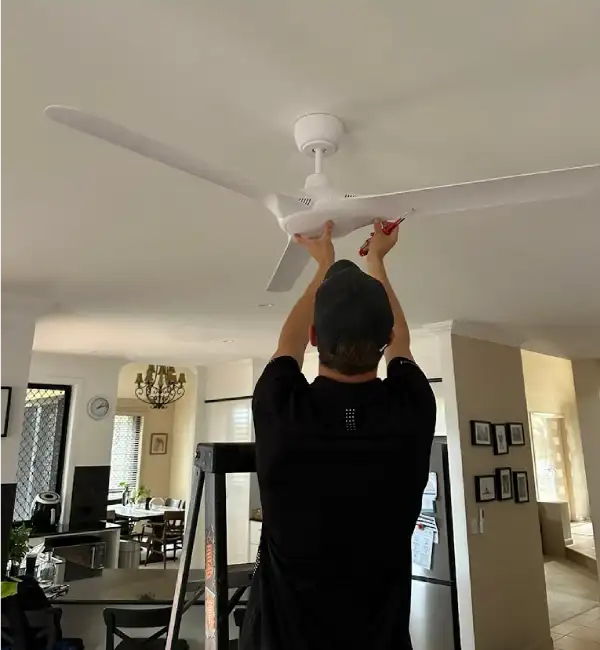
When you replace a fan, it’s also a good time to upgrade. Many modern fans use DC motors, which are quieter, offer more speed settings and use less power than many older AC models. That makes them well suited to bedrooms, where a fan runs all night. For our ceiling fan installation on the Gold Coast, we remove the old fan, check the existing wiring and switch setup, and fit the new one so it is ready to use straight away. Where a room has two light switches controlling the same circuit, we make sure the new fan works with that layout too.
Choosing the Right Fan for Each Room
A fan that is too small for the room will spin flat out and still leave the corners stuffy. Larger living areas and open-plan spaces usually need a bigger fan, or two fans spaced apart. In bedrooms, a fan positioned over the bed tends to give the best relief on humid nights.
Height matters for safety as well as comfort. Under Australian wiring rules, ceiling fan blades need to sit at least 2.1 metres above the floor. In rooms with low ceilings, a low-profile fan that mounts close to the ceiling is often the right choice. For raked or high ceilings, an extension rod brings the fan down to where it can move air effectively.
Outdoor Fans and Coastal Conditions
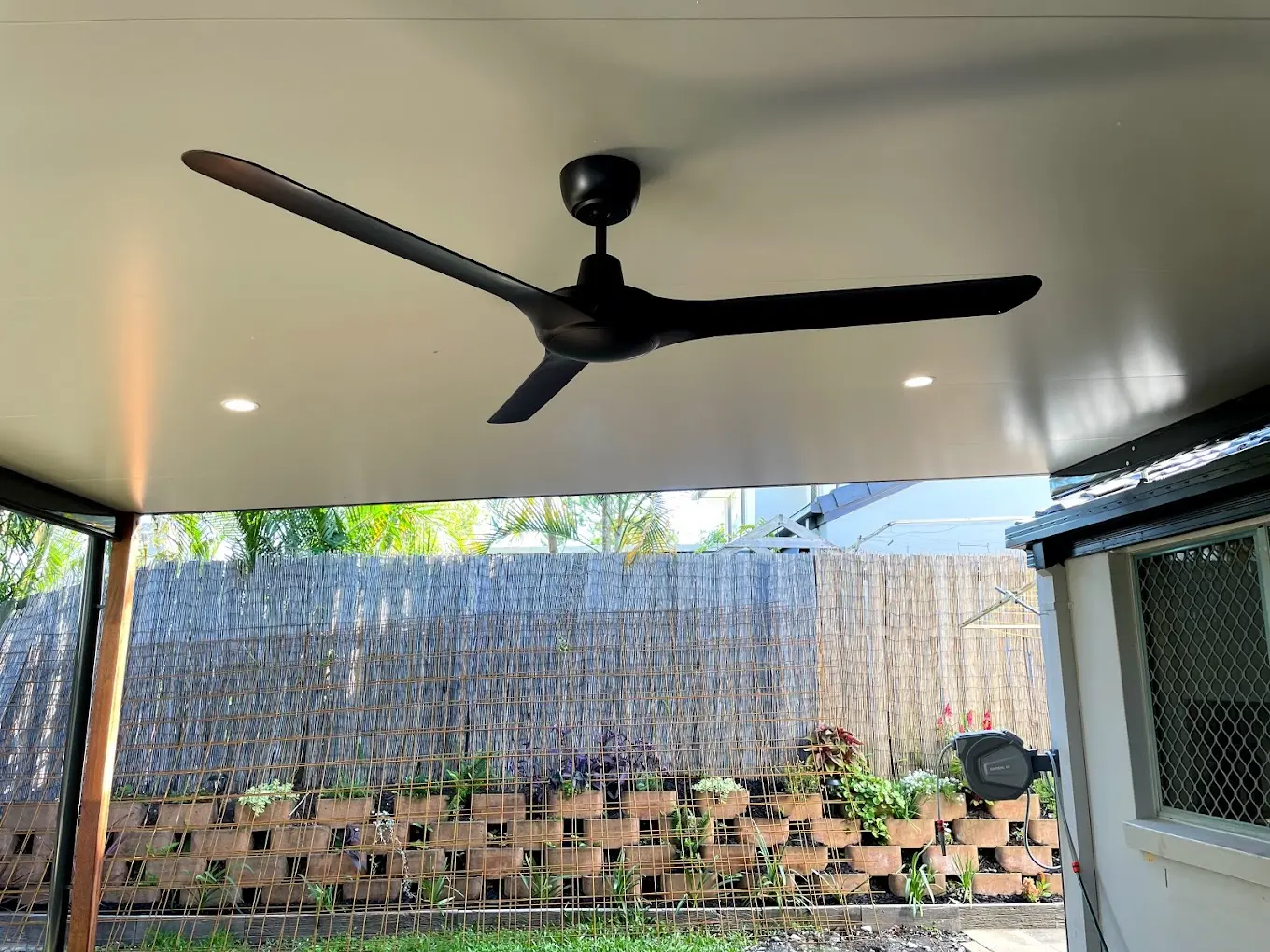
Patios, alfresco areas and balconies get a lot of use over a Gold Coast summer, and an outdoor fan makes them far more comfortable. Any fan mounted outside should be rated for outdoor use. Standard indoor fans aren’t built to handle moisture, and salt air in coastal suburbs speeds up corrosion on metal parts and electrical connections.
If you already have an outdoor fan, look for rust on the motor housing, blade brackets and mounting. Corrosion on an outdoor fan is more than a cosmetic problem, because it can weaken the fixings and let moisture into the wiring. Fans with sealed motors and blades made from materials that resist humidity tend to last much longer near the coast.
Ceiling Fans and Air Conditioning Work Well Together
A ceiling fan doesn’t cool the air. It moves it, which makes a room feel cooler through the breeze on your skin. Running a fan alongside your air conditioner helps spread the cool air through the room, so you may find you can set the air conditioner a little warmer and stay just as comfortable. On milder evenings, a well-placed fan is often enough on its own.
Because fans cool people rather than rooms, turn them off when you leave. There is no benefit to running a fan in an empty room.
Get Your Fans Summer Ready With MCH Electrical
If your fan is wobbling, noisy or simply not keeping up with the heat, our licensed team can inspect it, repair it or install a new fan before summer kicks in. MCH Electrical is a family-owned Gold Coast electrician with upfront pricing and a lifetime workmanship warranty. Contact us for a free quote, or call 07 5665 7013.